Showing posts with label Simon and Schuster. Show all posts

3.21.2021

Jump at the Sun


The True Life Tale of Zora Neale Hurston

Caitlyn Dlouhy Books

(Atheneum Books/ Simon & Schuster) 

(pub. 1.12.2021) 

48 pages

A True Tale with

A Cherry On Top   

A uthor: Alicia D. Williams
       and illustrator: Jacqueline Alcantara
C haracter: Zora Neale Hurston

O
 verview:
       
    "Zora was a girl who hankered for tales like bees for honey. Now, her mama always told her that if she wanted something, “to jump at de sun”, because even though you might not land quite that high, at least you’d get off the ground. So Zora jumped from place to place, from the porch of the general store where she listened to folktales, to Howard University, to Harlem. And everywhere she jumped, she shined sunlight on the tales most people hadn’t been bothered to listen to until Zora. The tales no one had written down until Zora."

T antalizing taste: 

     "Soon she got to thinking: I want to be a famous author too. So Zora jumped again. She got herself a typewriter, and her fingers got tah tappin' and all her Eatonville memories poured into them pages. One of her stories was even about a little girl, sitting atop a gatepost!"

And something more:  Alicia D. Williams writes in her Author's Note that "it was deeply inspiring to learn of this  unstoppable storycatcher who'd hopped into her Ford coupe, aptly named Sassy  Susie, and traveled throughout the South's back roads during a time of lynching and Jim Crow laws. Zora similarly traversed the deepest parts of Haiti, Jamaica, and the Bahamas and amassed cultural songs, dances, tales, religious practices, and children's games, so that we all may enjoy them today. If it is true that we learn from our ancestors, then her folklore collection is a vast treasure of knowledge."

12.13.2020

R-E-S-P-E-C-T

Aretha Franklin, The Queen of Soul

Atheneum Books for Young Readers

(Simon & Schuster)

(pub. 8.25.2020) 

 48 pages

A True Tale with

A Cherry On Top   

A uthor: Carole Boston Weatherford
       and illustrator: Frank Morrison
C haracter:  Aretha Franklin

O
 verview:
       
"Aretha Franklin was born to sing. The daughter of a pastor and a gospel singer, her musical talent was clear from her earliest days in her father’s Detroit church where her soaring voice spanned more than three octaves.

Her string of hit songs earned her the title “the Queen of Soul,” multiple Grammy Awards, and a place in the Rock & Roll Hall of Fame. But Aretha didn’t just raise her voice in song, she also spoke out against injustice and fought for civil rights.

This authoritative, rhythmic picture book biography will captivate young readers with Aretha’s inspiring story."

T antalizing taste:

D-E-B-U-T

            Fourteen, recording live, and nervous as can be.

            She cuts a gospel album, gives God the victory. 

V-O-I-C-E

            Aretha’s voice resounds with color and clarity,

            spanning three-plus octaves, the maestros all agree. 

G-R-O-O-V-E

            Aretha finds her groove when she’s rocking R&B.

            No woman of her time has more chart-toppers than

             she. 

R-I-G-H-T

            For the civil rights movement for racial equality,

            Aretha raises funds and gives concerts for free.


And something more:  Carole Boston Weatherford's Author's Note explains that "as a girl, Aretha learned to play piano by ear and sang with her sisters in the church choir. Touring the gospel music circuit with her father, she met singers Clara Ward and Mahalia Jackson and civil rights leader Martin Luther King Jr.

    At age fourteen, Aretha recorded her first album, Spirituals.  The music industry took notice, and by age eighteen, Franklin had landed a contract with Columbia Records... Franklin was not just an artist, though; she was also an activist. During the 1960s, she performed at benefit concerts to support the civil rights movement and quietly donated funds to bail protesters out of jail."

6.15.2020

The Power of Her Pen

The Groundbreaking Story
of the Journalist
Ethel L. Payne

Paula Wiseman Books
(Simon & Schuster)
(pub. 1.14.2020) 
48 pages

A True Tale with

A Cherry On Top   

A uthor: Lesa Cline-Ransome
 and illustrator:  John Parra
 
C haracter: Ethel L. Payne

O
 verview
     "Ethel Payne always had an ear for stories. Seeking truth, justice, and equality, Ethel followed stories from her school newspaper in Chicago to Japan during World War II. It even led her to the White House briefing room, where she broke barriers as the only black female journalist. Ethel wasn’t afraid to ask the tough questions of presidents, elected officials, or anyone else in charge, earning her the title, 'First Lady of the Black Press.'

         Fearless and determined, Ethel Payne shined a light on the darkest moments in history, and her ear for stories sought answers to the questions that mattered most in the fight for Civil Rights."

T antalizing taste: 
     "On Saturdays, once the house was spotless, Bessie took Ethel and her five siblings to the white side of town where there were libraries with shelves stacked tall with books. There, Ethel flipped through pages and memorized  passages to recite to anyone who would listen...
      Ethel walked a mile to school each day. The neighborhood residents  screamed and yelled and threw rocks at a black girl who dared to go to school  with whites. 'Sometimes I stood my ground, sometimes I got a bloody nose from fighting. But that was the way it was,' Ethel recalled later."
    
And something more: Ethel Payne said that she had a “box seat to history.” Due to her prominence in the black press, she was invited by President Lyndon Johnson to visit the White House when he signed both the Civil Rights Act of 1964 and the Voting Rights Act of 1965.  In 1988 the District of Columbia Women’s Hall of Fame inducted Payne into their ranks. She also won awards from the Chicago Council on Foreign Affairs and the National Association for Black Journalists.

2.23.2020

Dancing Hands

How Teresa Carreno
Played the Piano
For President Lincoln

Atheneum Books for Young Readers
(Simon and Schuster)
(pub. 8.27.2019) 
 40 pages

A True Tale with

A Cherry On Top   

A uthor: Margarita Engle
      and illustrator:  Rafael Lopez
 
C haracter: Teresa Carreno

O
 verview
     "As a little girl, Teresa Carreno loved to let her hands dance across the beautiful keys of the piano. If she felt sad, music cheered her, and when she was happy, the piano helped her share that joy. Soon she was writing her own songs and performing in grand cathedrals.
     Then a revolution in Venezuela drove her family to flee to the United States. Teresa felt lonely in this unfamiliar place, where few of the people she met spoke Spanish. Worst of all, there was fighting in her new home, too - a Civil War.
     Still, Teresa kept playing, and soon she grew famous as the talented Piano Girl who could play anything from a folk song to a sonata. So famous, in fact, that President Abraham Lincoln wanted her to play at the white House! Yet with the country torn apart by war, could Teresa's music bring comfort to those who needed it most?"

T antalizing taste: 
     "But the piano was poorly tuned, making her music sound ugly. What should she do? Refuse to play?
     She stopped, feeling discouraged, until Mister Lincoln smiled kindly and asked for his favorite song, 'Listen to the Mockingbird.' 
     Teresa knew she could play this lively piece even on an imperfect piano, so her fingers leaped across all the glorious dark and light keys, improvising the way mockingbirds do, the melody changing a she went along. Music swirled, twirled, and soared on wings of sound.
     The president listened quietly to notes that rose, swayed, rippled, and dipped like a bird in a blue sky above a green forest."

And something more: The Historical Note states that "Teresa Carreno became known as a composer and opera singer, as well as one of the best pianists of her era, playing with  such an intense spirit that audience members claimed they could hear the power of tropical nature in her music. She settled in Berlin, but returned to New York during World War I. Her remains, concert gowns, piano, and many of her documents were eventually returned to Venezuela, where she is remembered as La Leona ('The Lioness') of the piano."

11.10.2019

Our Flag Was Still There

The True Story 
of Mary Pickersgill
and the Star-Spangled
Banner

A Paula Wiseman Book
(Simon and Schuster)
(pub. 5.21.2019) 
48 pages

A True Tale with
A Cherry On Top   

A uthor and illustrator:  Jessie Hartland
 
C haracter:Mary Pickersgill

O
 verview from the jacket flap
     "If you go to the Smithsonian's National Museum of American History  in Washington, D.C., you can see a massive American flag: it's thirty feet tall and forty-two feet long. That's huge! But how did it get there? And where did it come from? Well...
     The story of that giant flag begins in 1812 and stars a major on the eve of battle, a seamstress and her mighty helpers, and a poet named Francis Scott Key. This isn't just the story of a flag. It's the story of the poem that became our national anthem, 'The Star-Spangled Banner.'
     Dynamically told and stunningly illustrated, this fascinating and true story is brought to life by Jessie Hartland."

T antalizing taste: 
     "The year was 1813. Only thirty years had passed since America's thirteen colonies fought long and hard for independence form Great Britain ... and we wanted to be free.
     But in 1813 we were once again at war with England ... And the British were on their way to capture Baltimore...There stood Major George Armistead, ready to lead American troops to defend Fort McHenry... George wanted to send a big message to the British:This land  belongs to America!
     'It is my desire to have a flag so large that the British will have no difficulty seeing it from a distance.'
     Lucky for George, not far away ... lived Mary Pickersgill.
     Mary had learned the flag-making trade from her widowed mother, who had also made blankets and uniforms during the Revolutionary War."

And something more: Jessie Hartland's Author's Note explains that "the flag discussed in this book was the second official version of [the American flag]. It had fifteen stripes and fifteen stars, acknowledging the two newest states at that time: Kentucky and Vermont. In 1818, the United States Congress passed an act to revert to the flag's original design, with thirteen stripes to honor the original thirteen colonies, and to continue adding a star from each new state.
     Major Armistead's heirs gave the flag to the Smithsonian Institution on the condition that it never be loaned out. They wanted the flag always on view ... The museum has kept its word with one notable exception: Fearing enemy attack during World War II, the flag was moved temporarily out of the city for safekeeping."

9.25.2017

The World Is Not a Rectangle

A Portrait of
Architect Zaha Hadid

Beach Lane Books
(Simon and Schuster)

(pub. 8.22.2017)
56 pages

A True Tale with
A Cherry On Top   

A uthor and illustrator: Jeanette Winter

C haracter: Zaha Hadid

O
 verview from the jacket flap: 

     "A young girl in Iraq saw the wild beauty of the rivers and marshes and dunes and ancient ruins in her country and dreamed of designing wild and beautiful cities of her own.
     Her name was Zaha Hadid.
     When she grew up, she became one of the most irreverent, controversial, and celebrated architects in the world.
     This is her story."

T antalizing taste: 
      
     "Zaha's designs don't look like other designs.
      Her buildings swoosh and zoom and flow and fly.
     'The world is not a rectangle.'
     No one wants to build her unusual designs. They say they can't be built, but Zaha knows they can.
     So she enters competition after competition, hoping to win, hoping someone will be brave enough to build them.
     ...  Hadid means iron in Arabic, and Zaha is strong as iron.  She keeps on working - one plan after another.
    'I made a conscious decision not to stop.' 
     Zaha remembers the grasses in the marshes swaying and sees tall buildings dancing like grass...
     Zaha remembers the wind in the dunes and feels it blowing over and around and through her desert building"
 
and something more: Jeannette Winter's Author's Note explains her inspiration for creating this wonderful book, The World Is Not A Rectangle: "When I first saw photos of Zaha Hadid's architectural designs in 2010, the buildings seemed to fly. My spirit also took flight - to a place in my imagination that only landscape had taken me before. I had to find out more about her." And, of course, I wanted to learn more also after reading her book. This article from The Guardian shows and describes ten of her wildly creative designs that lifted Jeannette Winter's spirit.

5.15.2017

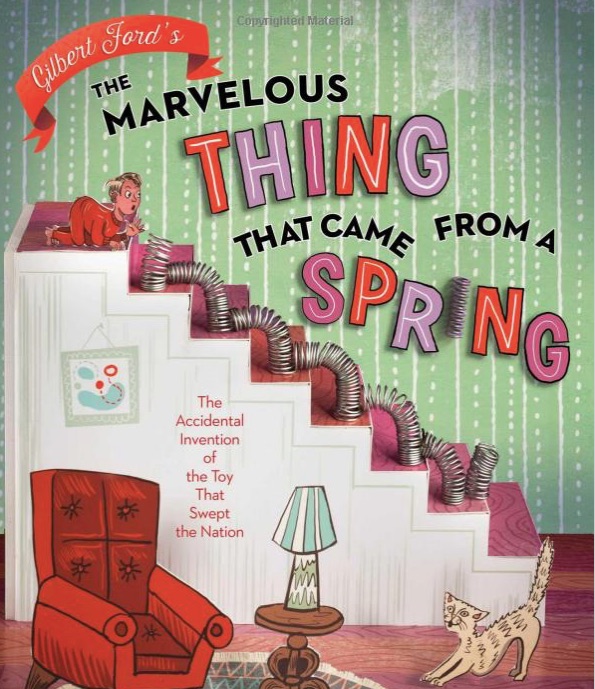
The Marvelous Thing That Came From A Spring

The Accidental Invention
of the Toy That 
Swept the Nation

Atheneum Books for Young Readers
(Simon & Schuster)
(pub. 9.1.2016)
40 pages

A True Tale with
A Cherry On Top  

uthor: Gilbert Ford
      and photographer: Greg Endries

C haracter: Richard and Betty James

O
 verview from the jacket flap: 

"One day a spring fell from the desk of Richard James, an engineer and a dreamer. Its coils took a walk ... and so did Richard's imagination. He knew right away that he had stumbled onto something marvelous.

Richard and his wife, Betty, took this ordinary spring and turned it into a plaything. But it wasn't just any old trinket - it was a Slinky, and it would become on of the most popular toys in American history.

With magnificent dioramic illustrations, Gilbert Ford captures the joy, creativity, and determination behind the invention of an iconic, one-of-a-kind toy."    

T antalizing taste: 
     
    "Betty thumbed through a dictionary for two days, underlining words. 
     Nothing sounded quite right ... until she found 'slinky' meaning 'graceful' and 'curvy in movement.' 'Slinky' also sounded like the swish and clink of the spring's coils in motion.
     It was only a name, but it was just right. With one word, Betty thought she could transform this spring into a one-of-a-kind thing!"

and something more: The Note at the back of the book provides interesting stories of other uses of the Slinky over time: "The Slinky was used as an antenna for radios during the Vietnam War, as a device for understanding wave mechanics, and as a therapy tool for patients who had suffered from strokes or other disorders. It was launched into space on the shuttle Discovery to help astronauts demonstrate how gravity worked. And the clinking coils of the Slinky even inspired a musician, John Cage, to create experimental music based on the sound!"

10.12.2014

Queen Victoria's Bathing Machine

This post joins other
kidlit bloggers on the
Nonfiction Monday Roundup
and also joins It's Monday!
What are you reading?

Paula Wiseman Books (Simon & Schuster Books)
(pub. 5.6.2014) 40 pages

A True Tale with 
A Cherry On Top

A uthor: Gloria Whelan
           and Illustrator: Nancy Carpenter
    
C haracter:  Queen Victoria

O verview from the jacket flap: 

    "No one ever said being queen would be easy. But one thing that Queen Victoria never thought about was not being able to swim - ever. It would be so indelicate to have your loyal subjects see your bathing suit and you, Her Royal Highness, in it! What is a queen to do?
     If you are Queen VIctoria with a smart and loving husband like Prince Albert, you have no worries because your husband will make sure you have a bathing machine that is fit for a queen.
     Inspired by royal history, National Book Aware recipient Gloria Whelan tells how a prince, believing that sea bathing was good for his wife's health, helped her to be able to swim as queen. Nancy Carpenter's Pen and watercolor illustrations evoke a loving family and a queen happy at last!"

T antalizing taste: 

"'My dear,' said Prince Albert, 'if it is your wish
to dabble and splatter and swim like a fish,
there must be a way to transport you with ease,
while keeping the populace from glimpsing your knees.
I'll give all my genius and all my attention
to devise a device, to invent an invention.'"

and something more: I enjoyed learning that after the queen's death, the bathing machine was used for a time as a chicken coop. It has now been restored and may be seen by all who visit Osborne House on the Isle of Wight.
     Gloria Whelan's author website includes insights into her writing life and philosophy. I thought this quote was quite wonderful (and I'm certain many children who read Queen Victoria's Bathing Machine do feel she's become a friend): 

"When I’m not writing or walking, I’m cooking or reading, mostly reading. I read a lot and when I put a book down, I feel the author has become my friend. I hope my readers feel the same way about me."